Bedding · Mattress construction
Inside Vispring: How Hand-Tufting and Natural Upholstery Shape Mattress Support
A mattress is more than its springs. In Vispring designs, pocketed coils, natural-fiber upholstery and hand-finished details work together to shape the feel of the surface—and how its layers are held in place over time. Understanding those choices can help shoppers compare models by construction, not just by a label such as “soft” or “firm.”
Published October 15, 2026
Look inside a traditional pocket-spring mattress and the design begins to resemble a small landscape of separate systems. Beneath the fabric lies a field of springs, each capable of responding to pressure. Above it, layers of upholstery soften the first impression and distribute weight. Running through the whole construction are stitches and tufts that help keep those layers where they belong.
Vispring offers a useful case study in how these components influence one another. Its mattresses combine pocket springs with fillings that can include wool, cotton, cashmere, silk or horsetail, depending on the model. Hand-tufting and side-stitching are not simply decorative flourishes: they are construction methods intended to secure materials and shape the mattress’s profile. The result is a particular balance of spring response, cushioning and surface character.
That does not mean that one construction is best for every sleeper. A mattress can be beautifully made and still feel wrong for a particular body, sleeping position or preference. To understand what hand-tufting and natural upholstery may contribute, it helps to follow the mattress from its outer surface inward.
The spring core: support in many small responses
In a pocket-spring mattress, each coil sits in its own fabric pocket. Because the springs are not joined into one continuous wire network, they can respond more independently than interconnected coils. When a shoulder or hip presses into the bed, the nearby springs compress while those around them may move less. This localized response is one reason pocket-spring designs are often described as contouring or responsive.
Spring count alone does not tell the whole story. Coil dimensions, wire properties, arrangement, tension, and the layers above the springs all contribute to the sensation under a sleeper. A high coil count is not, by itself, proof of superior support. Nor does a spring core act in isolation: upholstery changes how soon a sleeper encounters the springs and how their resistance is felt.
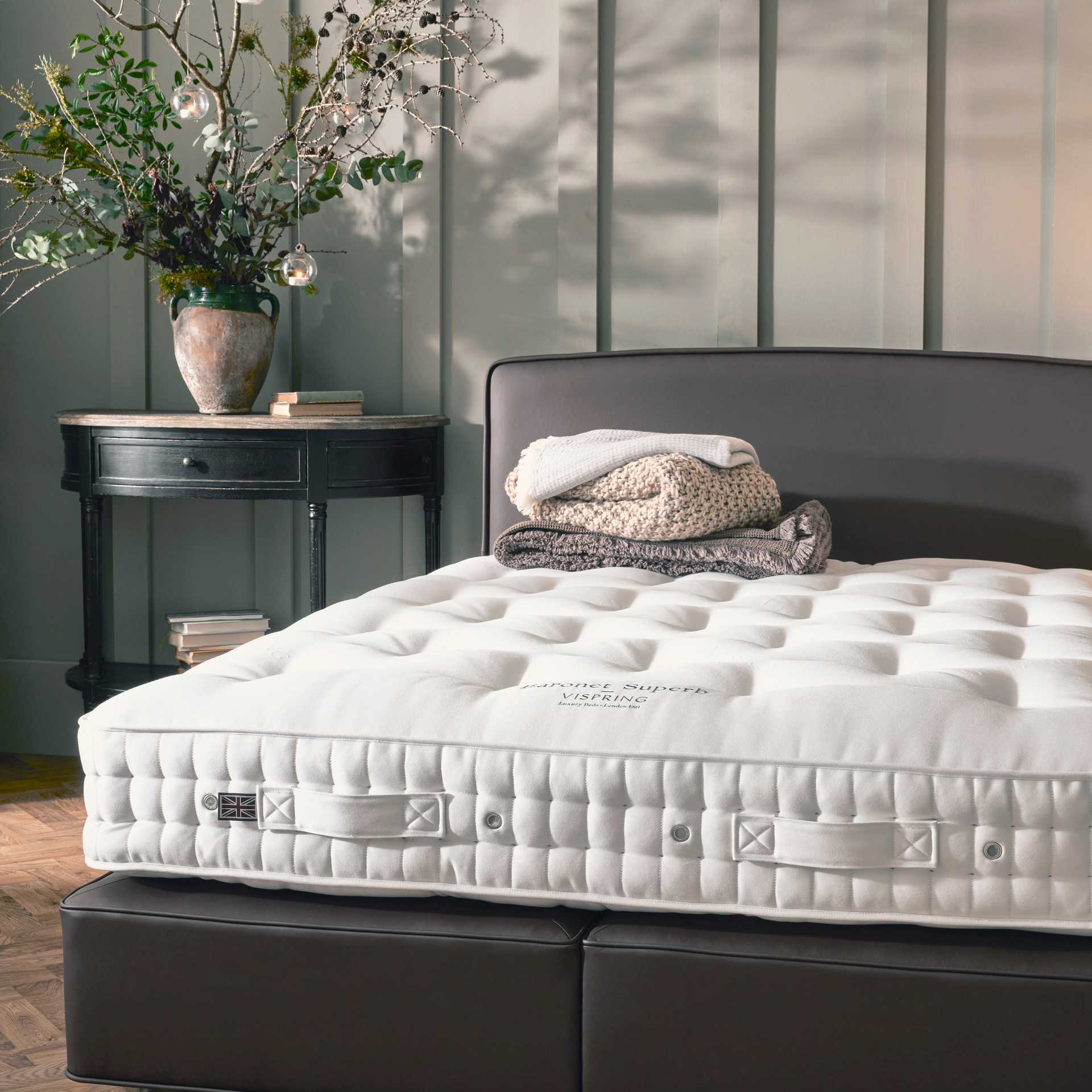
Consider the Vispring Baronet Superb. Its product details describe 1,716 Vanadium steel pocket springs in a King size, with four available tensions—Soft, Medium, Firm and Extra Firm. The specifications also note that a King can be ordered with split firmness across the width, allowing two sleepers to choose different tensions. These details describe options, not a universal prescription: the most suitable tension depends on the sleeper and should be assessed through an in-person trial where possible.
Independent spring movement may help limit the spread of movement across a mattress, but it does not guarantee complete motion isolation. The entire bed system—including its upholstery, frame and the movement itself—affects what a partner feels. For shoppers sharing a bed, it is worth testing this directly rather than assuming that the phrase “pocket spring” settles the question.
Natural upholstery: the layers between body and coils
The upholstery is the mattress’s transition zone. It determines much of the first contact: whether the surface feels yielding, buoyant, cushioned, warm or firm. Fibers can compress under weight, recover when pressure is removed, and respond differently to heat and moisture. A sequence of materials can create a more complex sensation than a single thick comfort layer.
Wool and cotton, for example, can provide a compressible buffer above the springs. Wool is also valued for its ability to absorb and release moisture, while cotton contributes a familiar textile feel. These characteristics are material properties, not guarantees that every sleeper will stay cool or dry. Room temperature, bedding, personal physiology and the specific construction all matter.
Some Vispring models use more specialized fillings. The Vispring Cashmere Superb is described as having a blended cashmere, silk and viscose ticking, followed by layers that include British fleece wool, cotton, hand-teased Austrian Moosburger horsetail, Real Shetland Wool, cash-hair, cashmere and silk. This layered arrangement combines materials with different textures and compressive qualities. In the product description, cashmere is noted for warmth, while silk and viscose are associated with moisture movement in the cover.
Horsetail is another distinctive element. Its natural crimp gives the fibers a springy quality, so the material can contribute resilience within the upholstery. That does not make it equivalent to a steel coil; it plays a different role, cushioning and responding within the upper layers rather than acting as the mattress’s main support core.
Natural materials are not automatically suitable for every person or situation. Sensitivities vary, and shoppers should review the complete materials list if they have allergies or other concerns. Natural filling also does not remove the need for sensible care. Protecting a mattress with an appropriate cover and following the maker’s instructions can help preserve its condition.
What hand-tufting actually does
Tufting is a way of anchoring the layers of a mattress. A tuft passes through the upholstery and is secured on the other side, drawing the materials into a controlled compression. In a hand-tufted mattress, this work is done by hand rather than relying solely on machine-made attachments. Some designs use woollen tufts; others may use a fastening with a felt washer.
Why compress layers that are meant to feel soft? Without restraint, loose filling can shift, gather or settle unevenly as a mattress is used. Tufts help hold the upholstery in position and maintain a consistent relationship between the materials and the spring core. They also contribute to the mattress’s surface profile. The small dimples visible at tuft points are evidence of that anchoring process.
Tufting is not a magic shield against wear. Every mattress changes with use, and the rate and pattern of change depend on its materials, construction, care and the loads placed on it. The technique should be understood as one part of a broader design intended to manage the upholstery, not as a promise that the bed will remain unchanged indefinitely.
On the Baronet Superb, the product description specifies hand tufting with felt washers, which draws the fillings into uniform compression. The Cashmere Superb description instead refers to hand-tied woollen tufts at regular intervals, intended to anchor the upholstery layers. The materials and finishing details differ, but the underlying purpose is similar: to keep the mattress’s layered structure organized under repeated use.
Side-stitching and the mattress edge
The perimeter matters because it is both a boundary and a working part of the sleep surface. A weak or poorly supported edge may compress more readily when someone sits down or sleeps near the side. In a hand side-stitched mattress, stitching binds the border to the mattress structure and helps stabilize the edge.
Vispring product details describe two rows of hand side-stitching on the Baronet Superb and three rows on the Cashmere Superb. The Cashmere model’s description states that its stitched border helps maintain firmness at the edge and keep the filling profile consistent. The Baronet description likewise connects its stitched border with support around the perimeter. These are useful construction distinctions, although the number of rows alone cannot establish how an individual mattress will feel at its edge.
When testing a mattress, sit near the side, then lie close to the edge in your usual sleeping position. Notice whether the surface feels stable and whether you can use the full width comfortably. If you share a bed, also consider whether both sleepers can rest without feeling drawn toward the center or the boundary.
A layered design is a conversation
It is tempting to assign a single job to each material: springs support, wool regulates temperature, cashmere softens. In practice, a mattress behaves as a system. The spring tension influences how far the body settles. Upholstery changes the pace and character of that settling. Tufts help restrain the fillings, and the border affects how the structure behaves near its edges.
On the Cashmere Superb, the described upholstery sequence moves through several layers before reaching the spring core. British fleece wool and cotton form one part of the sequence; horsetail, Shetland wool and cash-hair add other textures and resilience; another blend includes wool, cotton, cashmere and silk. The order matters because a sleeper encounters the upper layers first. Each contributes to the sensation created by the materials beneath it.
The Baronet Superb presents a more straightforward comparison point in the available product descriptions. It combines two upholstery layers of British fleece wool and cotton above its pocket springs. One is described as cushioning immediate contact; the other as helping moderate temperature by drawing moisture away from the body. Its simpler stated layer sequence should not be read as inferior. It is a different construction, and personal comfort depends on how the complete mattress feels to the person using it.
Mattress terms can obscure these differences. “Plush” and “firm” usually summarize a broad impression, but they do not reveal how the surface gives way or how quickly it pushes back. Two mattresses with similar firmness labels may feel markedly different because their spring tensions, upholstery materials and construction methods differ.
How to compare models in person
A product specification can explain what is inside a mattress, but it cannot predict every sleeper’s experience. If you are comparing models, spend enough time on each bed to notice more than the first impression. Wear comfortable clothing, use your normal sleeping position and allow your body to settle before judging the support.
- Check alignment and pressure. Notice how your shoulders, hips and lower back feel in your typical position. A surface that feels pleasant for a minute may not remain comfortable after several minutes of settled rest.
- Compare firmness by sensation, not name alone. “Medium” is not a universal measurement. Test the available tensions and ask whether the specification refers to the spring unit, the finished mattress, or both.
- Assess the edge. Sit and lie near the perimeter. Consider whether the usable sleeping area feels stable across its width.
- Test movement with a partner. Take turns changing position and pay attention to how much movement travels across the bed.
- Ask about the complete materials list. If a particular fiber, cover or treatment matters to you, verify the details for the exact model and size rather than relying on general brand language.
- Confirm the practical details. Ask about the required base, care instructions, delivery, trial or return terms, warranty and whether a mattress needs turning or rotating.
A split-tension option can be valuable where two people have different preferences, but it is important to understand how the split is constructed and whether it creates a noticeable boundary. Likewise, natural fillings may appeal to someone seeking a particular tactile or temperature experience, but material descriptions should be weighed alongside actual comfort and care needs.
Durability, maintenance and realistic expectations
Hand-tufting, side-stitching and resilient fillings are construction choices associated with keeping a mattress’s components in place and supporting its form. They do not make a mattress immune to aging. Foam, fibers and springs all experience repeated loading; comfort may change gradually even when a mattress remains structurally usable.
Good maintenance begins with following the manufacturer’s instructions. Use a foundation compatible with the mattress, protect the surface from spills and avoid bending or folding a mattress unless the maker says that it is designed for that use. A breathable mattress protector can help limit soiling while allowing the bed to function as intended, though the protector itself may change the surface feel slightly.
Ask whether a particular mattress should be rotated or turned. Some designs are one-sided, while others may have different care requirements. Do not assume that advice for one model applies to another. Keeping a record of the purchase date and reviewing warranty terms can also help set realistic expectations about what the warranty covers; ordinary changes in comfort are not necessarily treated the same as a manufacturing defect.
The value of looking beneath the label
Vispring’s construction illustrates why mattress support is not a single component. Pocket springs respond beneath the body; natural upholstery shapes the first contact and cushions the spring system; hand-tufting helps anchor those fillings; and side-stitching reinforces the perimeter. Together, these details create a specific design language—one that may feel inviting to some sleepers and unsuitable to others.
For a shopper, the most useful question is not whether a mattress contains a prestigious fiber or a particular number of springs. It is how the complete construction behaves for the body that will sleep on it. Use specifications to understand what you are testing, then let a careful, unhurried trial answer the questions that a materials list cannot.
Seen from the outside, a mattress is a quiet rectangle. Seen from within, it is a layered structure designed to manage pressure, movement, moisture and repeated use. Hand-tufting and natural upholstery help explain how that structure holds together and why two spring mattresses can offer profoundly different experiences. The details do not replace personal comfort; they give it a clearer context.